Housecall Pro Pricing (2026): What Each Plan Really Includes
Two plumbers ask what Housecall Pro costs. One works alone out of a van; the other runs six trucks and lives off maintenance contracts. Both get told $59/mo, and only one of them is going to pay it.
That’s the number everyone quotes, and it’s real. It just isn’t the one most businesses end up paying. Your bill is set by which tier holds the one feature you came for, and Housecall Pro puts several of the big ones a long way up the ladder. Every figure below comes off their own pricing page.
Housecall Pro runs Basic $59/mo (1 user), Essentials $149/mo (5 users) and MAX $299/mo (8 users), all billed annually. Flat-rate pricing and the QuickBooks sync start on Essentials. Recurring service plans (the self-renewing maintenance agreement) are MAX only. And because seats come bundled instead of sold one by one, Housecall Pro looks better the bigger your team gets.
The price list
| Plan | Billed monthly | Billed annually | Users included |
|---|---|---|---|
| Basic | $79/mo | $59/mo | 1 |
| Essentials | $189/mo | $149/mo | 5 |
| MAX | $329/mo | $299/mo | 8 |
Annual billing saves $20–40/mo depending on tier. There’s a 14-day free trial with no card required, and no contract.
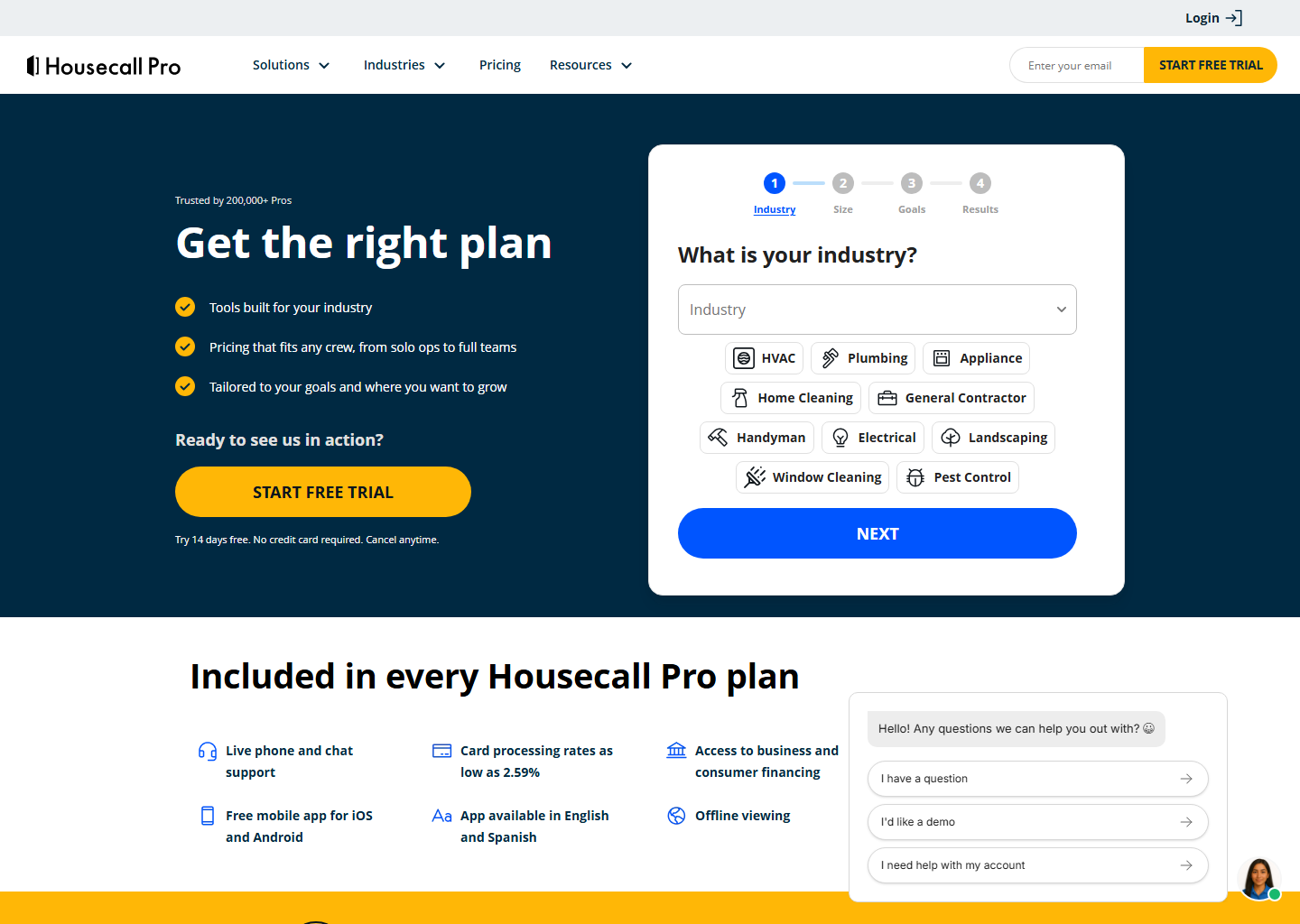
A warning about that page. Housecall Pro leads with a quiz (industry, team size, goals) and the plan table sits behind it. If you visit and conclude they’ve gone back to hiding prices, they haven’t. Worth knowing before you hand a sales team your phone number to learn a number that’s already published.
What’s actually in each plan
Basic, $59/mo, 1 user. Online booking, invoices and payments, scheduling and dispatching, quotes and proposals, review management, price book, job costing.
That’s a complete tool for a solo operator. It’s not a platform for running a team or a maintenance business: no route planning, no GPS, no QuickBooks sync, no flat-rate pricing.
Essentials, $149/mo, 5 users. Everything in Basic, plus:
- Flat-rate pricing: quoting the job at the door instead of by the hour
- QuickBooks Online sync
- Routes
- Checklist automations
- Photo reports and annotations
- Employee GPS tracking
- Commissions
This is the tier most small teams actually belong on, and the jump from Basic is steep in both price and capability. Note the seat count: five users included, not one.
MAX, $299/mo, 8 users. Everything in Essentials, plus:
- Recurring Service Plans: maintenance agreements customers can view, renew and upgrade themselves
- Route optimization (Essentials gets routes; MAX gets them optimised)
- Sales proposal tool, which Housecall Pro sells at $40/mo to lower tiers
- Open API access
- Dedicated onboarding specialist and escalated phone support
If you sell maintenance agreements, read that first bullet again. For an HVAC, plumbing or pest control business built on service plans, the entry price to Housecall Pro isn’t $59. It’s $299/mo billed annually. That’s published, not hidden, but nobody tells you before you’ve spent a week of the trial on Basic wondering where the feature is.
The seat maths nobody does
Almost every comparison puts “Housecall Pro from $59” next to “Jobber from $29” and calls Housecall Pro twice the price. At one user that’s exactly right. Add people and it stops being right, because the two companies sell seats in opposite ways: Housecall Pro bundles users into the tier; Jobber charges $29/mo per seat on top.
Lining the plans up where the seat counts match:
| Team size | Housecall Pro | Jobber |
|---|---|---|
| 1 user | Basic, $59/mo | Core, $29/mo |
| 5 users | Essentials, $149/mo | Connect, $149/mo |
| 10 users | MAX, $299/mo (8 users) | Grow, $299/mo · Connect, $229/mo |
All figures billed annually. These aren’t feature-for-feature equivalents, just the tiers where the headcount lines up. The shape is what matters: the “twice the price” gap closes to nothing at five users and never returns to anything like 2×. If you’re solo, Jobber genuinely is half the money. If you have a crew, price both properly instead of repeating the received wisdom.
One caveat in Jobber’s favour, and it got bigger: its extra seats are $29/mo against $75/mo on Housecall Pro Max, so past the eighth user Jobber’s marginal seat costs well under half. Our Jobber pricing guide covers that side in full.
What every plan includes
Housecall Pro publishes what comes with every tier, and it’s more generous than most:
- Live phone and chat support
- Free mobile app for iOS and Android, in English and Spanish
- Card processing as low as 2.59%
- Access to business and consumer financing
- Offline viewing
- AI features (“AI team members to automate your work”)
- A community of 30,000+ home service pros
The bilingual app is a genuine differentiator: if your crew works in Spanish, that alone is a reason to shortlist Housecall Pro. Consumer financing is not, despite being sold as one everywhere: it runs on Wisetack, the same lender Jobber uses. What Housecall Pro does better there is publish the terms: $500 to $65,000, up to 120 months, 0–35.9% APR, flat 3.9% merchant fee per transaction.
The costs that aren’t the subscription
- Card processing: 2.59% to 3.49% depending on how the card is taken, and 1% for ACH. On $40,000/mo of card revenue that’s $1,036–$1,396 a month, several times the software bill. Nobody shops on this and everybody pays it.
- Extra users: $100/mo each on Essentials, $75/mo each on MAX.
- The sales proposal tool: $40/mo on Basic and Essentials, included in MAX.
- Add-on prices exist, just not on the pricing page. Not one of Housecall Pro’s add-ons carries a figure where you’d look for it. Several are published anyway, scattered through the help centre and standalone landing pages: vehicle GPS $20 per vehicle/mo, dashcams $49 per device/mo, Campaigns from $9/mo (by SMS and email volume, up to $89), Voice call tracking from $45/mo ($65 with VoIP), and managed websites $99/mo ($149 advanced, plus a $99 setup fee).
- Two add-ons are genuinely a sales conversation: CSR AI and Accounting both send you to a contact form. For Pipeline, Payroll and Business Coaching we found no official figure and no “contact sales” either, so ask before you commit.
- Monthly billing costs $20–40/mo more than annual, on every tier.
Budget for all of that separately. The sticker price of your plan is not what you’ll pay.
Which plan should you actually pick?
- Solo operator, no maintenance agreements: Basic, $59/mo. Upgrade when a specific missing feature costs you money, not before.
- You price by the job, not the hour: Essentials. Flat-rate pricing lives there, and so does the QuickBooks sync your bookkeeper will ask for.
- Small team of 3–5: Essentials, and note you aren’t paying per head until the sixth.
- You sell maintenance or service agreements: MAX. There’s no cheaper route to recurring service plans inside Housecall Pro, so the question is whether the agreements cover $299/mo. For a shop with a real installed base, one or two saved renewals a month does it.
- Everyone: take the 14-day trial first, no card, and push real jobs through it.
How it compares
- Jobber: half the price at one user, level at five, cheaper per marginal seat. Better quoting; no equipment records.
- ServiceTitan: quote-only, per technician, a different league of cost and capability.
- Thinking of leaving? We mapped the realistic exits in Housecall Pro alternatives.
Quick questions people always ask
How much does Housecall Pro cost per month? Basic $59, Essentials $149, MAX $299, all billed annually. Monthly billing runs $79, $189 and $329. Basic includes 1 user, Essentials 5, MAX 8. Extra users are $100/mo each on Essentials and $75/mo on MAX.
Which plan has service plans and maintenance agreements? MAX only. Recurring Service Plans are listed as a MAX feature, so an agreement-based business is looking at $299/mo billed annually regardless of team size.
Which plan do I need for QuickBooks? Essentials or MAX, the QuickBooks Online sync isn’t on Basic. It’s one-directional, Housecall Pro to QuickBooks, and fires when a job is marked finished, sent or paid.
Is Housecall Pro cheaper than Jobber? At one user, no: $59 against $29 annually. At five users they’re both $149/mo, because Essentials bundles five seats while Jobber’s five-user Connect plan lands on the same number. Compare at your actual headcount, not at the entry price.
Why doesn’t the pricing page show prices? It does, the table sits below a four-step quiz asking your industry, team size and goals. The quiz tailors which plan and add-ons you’re pitched. Scroll past it and the numbers are there.
Is there a contract or a setup fee? No contract and no published setup fee; billing is monthly or annual and you can cancel. The trial is 14 days with no card.
Bottom line
Housecall Pro’s real price is $59, $149 or $299 a month, and which one you pay is decided by a single feature, not by how big you are. Flat-rate pricing puts you on Essentials. Maintenance agreements put you on MAX. If neither applies, Basic is a complete tool for a solo operator and the cheapest honest way in. And whatever tier you land on, look harder at the 2.59–3.49% card processing than at the subscription: that’s where the money actually goes.
Read next: Housecall Pro review · best software for HVAC businesses · Jobber pricing explained.
Pricing verified on housecallpro.com on 29 July 2026. Some links are affiliate links — see our affiliate disclosure. Screenshots belong to their respective owners.